Making biopackaging from paper and leaf waste for women in the family welfare empowerment program and early childhood education teachers

Downloads
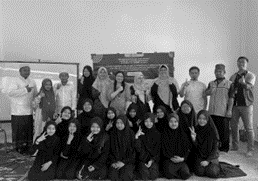
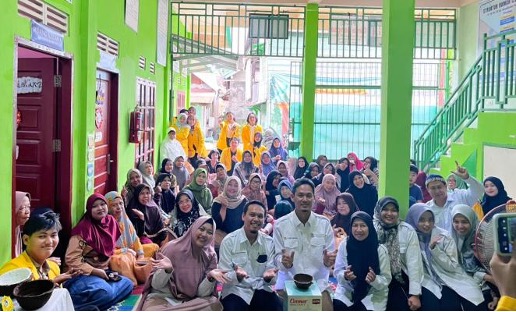
Various creative approaches can be developed to reduce the generation of both organic and inorganic waste. On the other hand, office and school paper waste, as well as plant matter such as dry leaves, are still not being utilized optimally. Biopack is an innovative cardboard container made from a mixture of paper pulp and dry leaves. This product can be used as eco-friendly packaging because it easily degrades when disposed of in soil or water after use. School paper waste and dry leaves available in the Wanaasri Palembang area hold significant potential as raw materials for Biopack. Utilizing this potential is expected to increase public awareness, particularly among the PKK Rumah Cinta Dahlia Wanaasri and the teachers at PAUD Permata Bunda, as key drivers in promoting the innovation of waste management into economically valuable products that can support the establishment of community-based businesses or entrepreneurship. This community service activity was carried out through outreach and a biopack-making demonstration using lectures and hands-on simulations. The evaluation was conducted through a questionnaire to analyze the level of effectiveness and the potential for sustainability of the activity. Survey results from activity participants revealed that 93% were not yet able to recycle used paper and leaves, 63% still disposed of used paper and leaves in trash bins, and 93–100% of participants rated the activity as beneficial, noting that it broadened their knowledge and understanding of making biopack from used paper and leaves, and that they liked the biopack products and were able to use them at home. Furthermore, it is hoped that the Wanaasri community will be able to produce its own biopack, that it will be adopted by teachers at the Permata Bunda Early Childhood Education Center as a teaching aid in the learning process, and that it will eventually be commercialized.
Arfah, M. (2017). Pemanfaatan Limbah Kertas Menjadi Kertas Daur Ulang Bernilai Tambah Oleh Mahasiswa. Buletin Utama Teknik, 13(1), 28–31. https://doi.org/10.30743/but.v13i1.257
Aziz, R., & Nitri, S. (2018). Jurnal Dampak Studi Daur Ulang Sampah Kertas dari Sumber Institusi di Kota Padang. Jurnal Dampak, 15(2), 77–81. https://doi.org/https://doi.org/10.25077/dampak.15.2.77-81.2018
Badan Pengendalian Lingkungan Hidup. (2025). Statistik Pengelolaan Sampah Kota Palembang. Sistem Informasi Kinerja Pengelolaan Sampah Nasional. https://sampahnasional.kemenlh.go.id/
Badan Pusat Statistik. (2023). Kecamatan Kalidoni Dalam Angka 2023 (BPS Kota Palembang (ed.)). BPS Kota Palembang.
Bie, M., Zhao, W., Dong, H., Gu, Y., Yuan, S., & Song, K. (2025). From Agricultural Waste to Recyclable Biodegradable Packaging : A Systematic and Bibliometric Review. Sustainability, 17, 1–26. https://doi.org/https://doi.org/10.3390/su172310742
Dinas Lingkungan Hidup Kota Palembang. (2023). Presentase Komposisi Sampah di Kota Palembang Tahun 2023. Satu Data Palembang. https://satudata.palembang.go.id/id/dataset/presentase-komposisi-sampah-di-kota-palembang-tahun-2023
Frezy, F. R., Febriyanti, D., & Amaliatulwalidain. (2025). Kinerja Dinas DLHK Kota Palembang dalam Pengelolaan Sampah di TPA Sukawinatan Kecamatan Sukarame Palembang. Jurnal Ilmu Administrasi Dan Studi Kebijakan (JIASK), 7(2), 119–134. https://doi.org/10.48093/jiask.v7i2.281
Ganing, M., Khatimah, N. K., & Adawiyah, S. U. Al. (2025). Inovasi Pengolahan Limbah Kertas untuk Kemasan Ramah Lingkungan Di Percetakan Daenk Fajar, Bone. Jurnal GEMBIRA (Pengabdian Kepada Masyarakat), 3(3), 899–906. https://gembirapkm.my.id/index.php/jurnal/article/view/978
Hidayat, A. S., Suciati, L. P., & Sudarko. (2023). Strategi Pengembangan Pupuk Organik Berbasis Limbah Ternak dan Limbah Pertanian di Kabupaten Jember Strategy. Jurnal Agribest, 7(1), 40–53. https://doi.org/https://doi.org/10.32528/agribest.v7i1.9309
Irfan, Sulaiman, I., & Werdana, M. O. (2020). Kajian Pemanfaatan Limbah Kertas Percetakan Untuk Pembuatan Bokasi. Jurnal Teknologi Dan Industri Pertanian Indonesia, 12(01), 29–35. https://doi.org/https://doi.org/10.17969/jtipi.v12i1.16214
Kamsiati, E., Rejeki, S., Marlina, L., Rusdin, A., & Su, M. (2024). Efektivitas Bioplastik Berbasis Limbah Pertanian sebagai Solusi Pengurangan Sampah Plastik : Tinjauan Literatur Sistematis. Nusantara Technology and Engineering Review, 2(2), 44–53. https://doi.org/https://doi.org/10.55732/nter.v2i2.1469
Kementerian Lingkungan Hidup Republik Indonesia. (2025). Timbulan sampah Nasional 2025. Sistem Informasi Pengelolaan Sampah Nasional (SIPSN). https://sampahnasional.kemenlh.go.id/indikatif/public/data/timbulan
Kurniawan, U., & Wakhid, A. (2008). Pemanfaatan Limbah Daun Kering Dan Kertas Daur Ulang Sebagai Bahan Dasar Pembuatan Scrapbook. Pelita – Jurnal Penelitian Mahasiswa UNY, 4(1), 89–97. https://jurnal.uny.ac.id/index.php/pelita/article/view/4288
Latif, A., Sulastri, A., Sutomo, M. A., Sudrajat, M., Akmal, N., Pangestu, R. A., Lestari, S. I., Rodiah, S., & Kholipah, W. (2022). Daur Ulang Sampah Kertas Menjadi Produk Kerajinan Multiguna Recycle Paper Waste into Multipurpose Craft Products. ALMUJTAMAE: Jurnal Pengabdian Masyarakat, 2(3), 255–260. https://doi.org/10.30997/almujtamae.v2i3.5516
Mufridayati, Humaidi, S., & Simbolon, T. R. (2015). Pembuatan dan Karakterisasi Kertas dari Campuran Serat Jambul Nanas dan Serat Jerami Padi. Saintia Fisika, 2(1), 1–6. https://repositori.usu.ac.id/handle/123456789/77595
Noor, A., Afriani, F., Puriza, M. Y., & Tiandho, Y. (2020). Bio-packaging based on a composite of paper waste and coconut fiber Bio-packaging based on a composite of paper waste and coconut fiber. 2nd International Conference on Green Energy and Environment, 1–4. https://doi.org/10.1088/1755-1315/599/1/012051
Ridhuan, K., Asroni, P, R. A., & Ahmad, Z. (2024). Analisa Kinerja Alat Incenerator Pembakar Sampah Tanpa Asap Yang Ramah Lingkungan. TURBO, 13(02), 287–294. https://doi.org/http://dx.doi.org/10.24127/trb.v13i2.3547
Rosyidah, N., & Sa’diyah, K. (2022). Pengaruh berbagai jenis biomassa terhadap hasil asap cair pada proses pirolisis. Distilat, 8(9), 900–908. https://doi.org/https://doi.org/10.33795/distilat.v8i4.443
Saputra, A. Z. D., & Fauzi, A. S. (2022). Pengolahan Sampah Kertas Menjadi Bahan Baku Industri Kertas Bisa Mengurangi Sampah di Indonesia. Jurnal Mesin Nusantara, 5(1), 41–52. https://doi.org/10.29407/jmn.v5i1.17522
Siciliano, S., Giovanna, C., & Francesco, L. (2024). From traditional packaging to smart bio ‑ packaging for food safety : a review. Euro-Mediterranean Journal for Environmental Integration, 9(4), 1971–1986. https://doi.org/10.1007/s41207-024-00627-8
Tobroni, M. I., & Gayatri, D. (2018). Pemanfaatan Hasil Limbah Kertas Pada Tugas Mata Kuliah Praktik Desain Komunikasi Visual Universitas Bina Nusantara. Dimensi DKV Seni Rupa Dan Desain, 3(2), 175–190. https://doi.org/https://doi.org/10.25105/jdd.v3i2.3603
Wang, K., & Tester, J. W. (2023). Green Energy and Resources Sustainable management of unavoidable biomass wastes. Green Energy and Resources, 1(1), 100005. https://doi.org/10.1016/j.gerr.2023.100005
Copyright (c) 2026 Rahmatullah Rahmatullah, Muhammad Djoni Bustan, Budi Santoso, Harry Waristian, Rizka Wulandari Putri, Rianyza Gayatri

This work is licensed under a Creative Commons Attribution-ShareAlike 4.0 International License.